
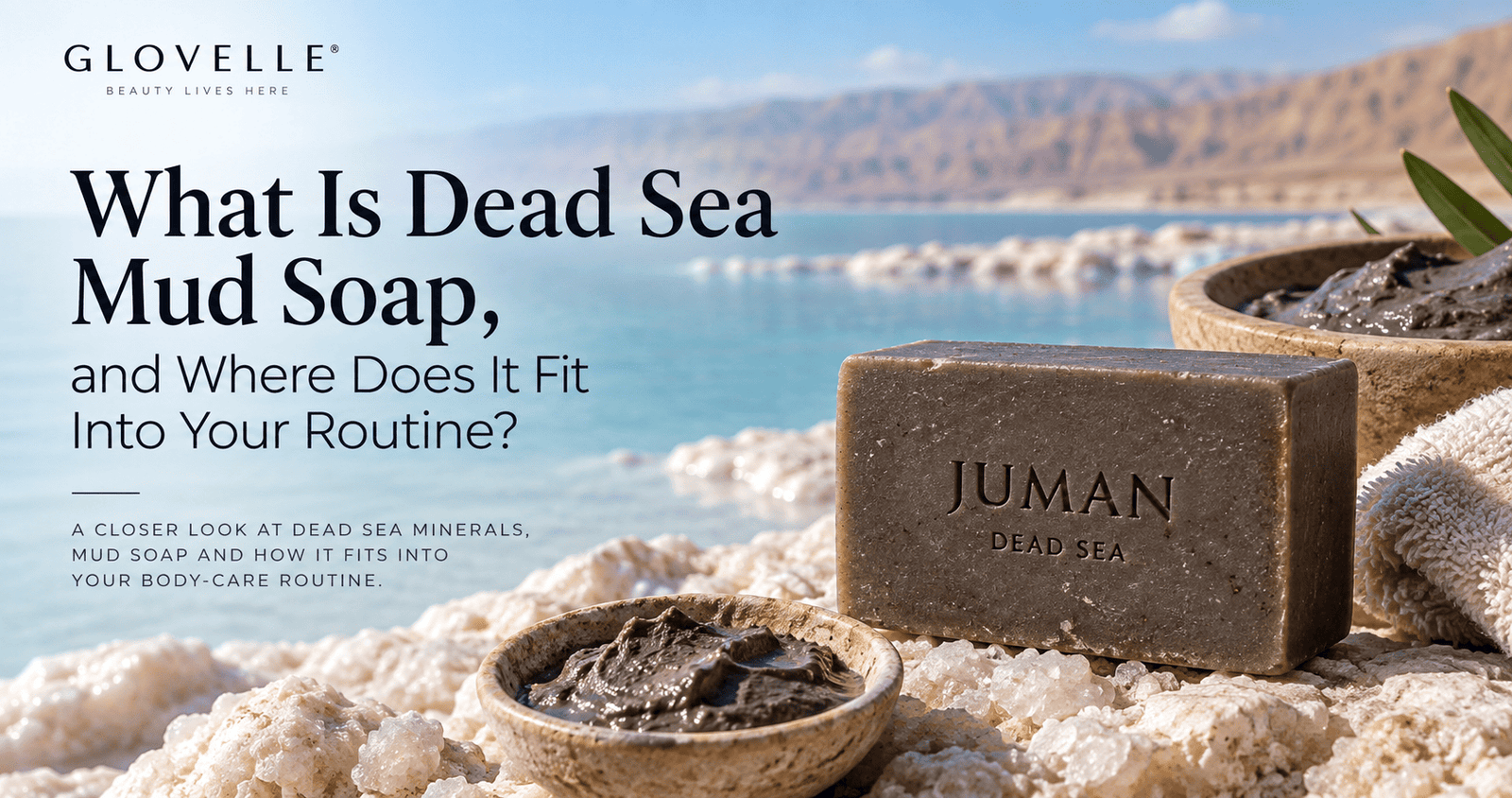
Mud and soap may sound like an unusual combination. Around the Dead Sea, however, mineral-rich mud has found its way into a range of body-care products, from masks and scrubs to cleansing bars.
Mud soap brings this ingredient into one of the simplest parts of a body-care routine: cleansing.
But what does the mud actually add, and how does mud soap differ from other Dead Sea products?
What Makes the Dead Sea Different?
Much of the interest surrounding Dead Sea body care begins with the unusual composition of the water itself.
Dead Sea water contains a particularly high concentration of dissolved salts, including magnesium, calcium, potassium, and sodium. Its mineral balance differs considerably from that of ordinary seawater, which is one reason the region has attracted interest in dermatology and cosmetic research.
There is some science behind that interest. One controlled study involving people with atopic dry skin examined the effects of bathing the forearm in a magnesium-rich Dead Sea salt solution. The researchers reported improvements in measures of skin hydration and barrier function compared with those observed in the area exposed to tap water.
There is an important distinction, though. The study involved bathing in a mineral-rich solution, not washing with a bar of soap.
A bath, a mud application, a mask, and a rinse-off cleanser expose the skin to ingredients in very different ways. Research into Dead Sea minerals can help us understand why these ingredients continue to attract interest, but it does not mean every cosmetic containing them will produce the same effects.
Where Does the Mud Come Into the Picture?
Dead Sea mud is not simply Dead Sea water in another form. It contains mineral-rich material from the region, giving it characteristics that have led to its use in different types of body-care products.
Research has also examined Dead Sea mud itself. In one study involving healthy volunteers, several Dead Sea mud preparations were generally well tolerated and did not compromise the skin-barrier measurements assessed by the researchers. The study did not find a significant improvement in hydration across the mud preparations, which is a useful reminder that the evidence surrounding an ingredient can be more nuanced than the claims sometimes associated with it.
How the mud is incorporated into a finished product also matters.
A mud mask, for example, normally remains on the skin for a period of time before being rinsed away. Mud soap remains in contact with the skin for a much shorter time because its primary purpose is cleansing.
Both may contain Dead Sea mud, but they are used differently and should not be expected to behave in exactly the same way.
Seeing Mud Soap in Use
The difference between mud soap and a mud mask becomes clearer when you see how each is used. A mask is normally applied as a separate step, while mud soap remains part of the cleansing process.
The accompanying video demonstrates this using JUMAN Mud Soap. It shows the bar itself, how it lathers with water, and how it is used on the skin before being rinsed away.
Despite the presence of Dead Sea mud, the process is much like using any other cleansing bar. The difference lies in the formulation rather than in adding another step to the routine.
There Is More to Mud Soap Than the Mud
“Mud” may be the ingredient that first catches your attention, but it does not tell you everything about the product.
A finished soap is a complete formulation. The amount and form of Dead Sea mud, the other ingredients in the formula, how the soap is used, and how an individual’s skin responds all matter.
The same caution applies when considering individual minerals. Magnesium, calcium, potassium, and other components of the Dead Sea may be interesting from a research perspective, but their presence alone does not establish what a finished rinse-off product will do.
For mud soap, the simplest description is often the most useful: it is first and foremost a cleanser with Dead Sea mud incorporated into the formula.
Where Might It Fit Into a Routine?
For someone curious about Dead Sea mud, soap provides a straightforward way to incorporate the ingredient into an already familiar step: cleansing.
That is quite different from adding a mud mask or another treatment to your routine. Whether a particular mud soap suits you will ultimately depend on its complete formulation, how you use it, and how your skin responds.
This is also a useful way to approach Dead Sea body care more generally. Rather than focusing on a single ingredient and expecting it to do everything, start with what the product is designed to do and then consider how its ingredients fit into that purpose.
The JUMAN Mud Soap featured in the video is available in Malaysia through MyTradeMartStore.
References
- Proksch E, Nissen HP, Bremgartner M, Urquhart C. (2005). Bathing in a magnesium-rich Dead Sea salt solution improves skin barrier function, enhances skin hydration, and reduces inflammation in atopic dry skin. International Journal of Dermatology, 44(2), 151–157. DOI: 10.1111/j.1365-4632.2005.02079.x.
- Hamed S, Almalty AM, Alkhatib HS. (2021). The cutaneous effects of long-term use of Dead Sea mud on healthy skin: a 4-week study. International Journal of Dermatology, 60(3), 332–339. DOI: 10.1111/ijd.15304.
Disclosure: JUMAN Dead Sea products are imported and distributed in Malaysia by Relev Tech Sdn. Bhd. Relev Tech also operates MyTradeMartStore and Glovelle.