
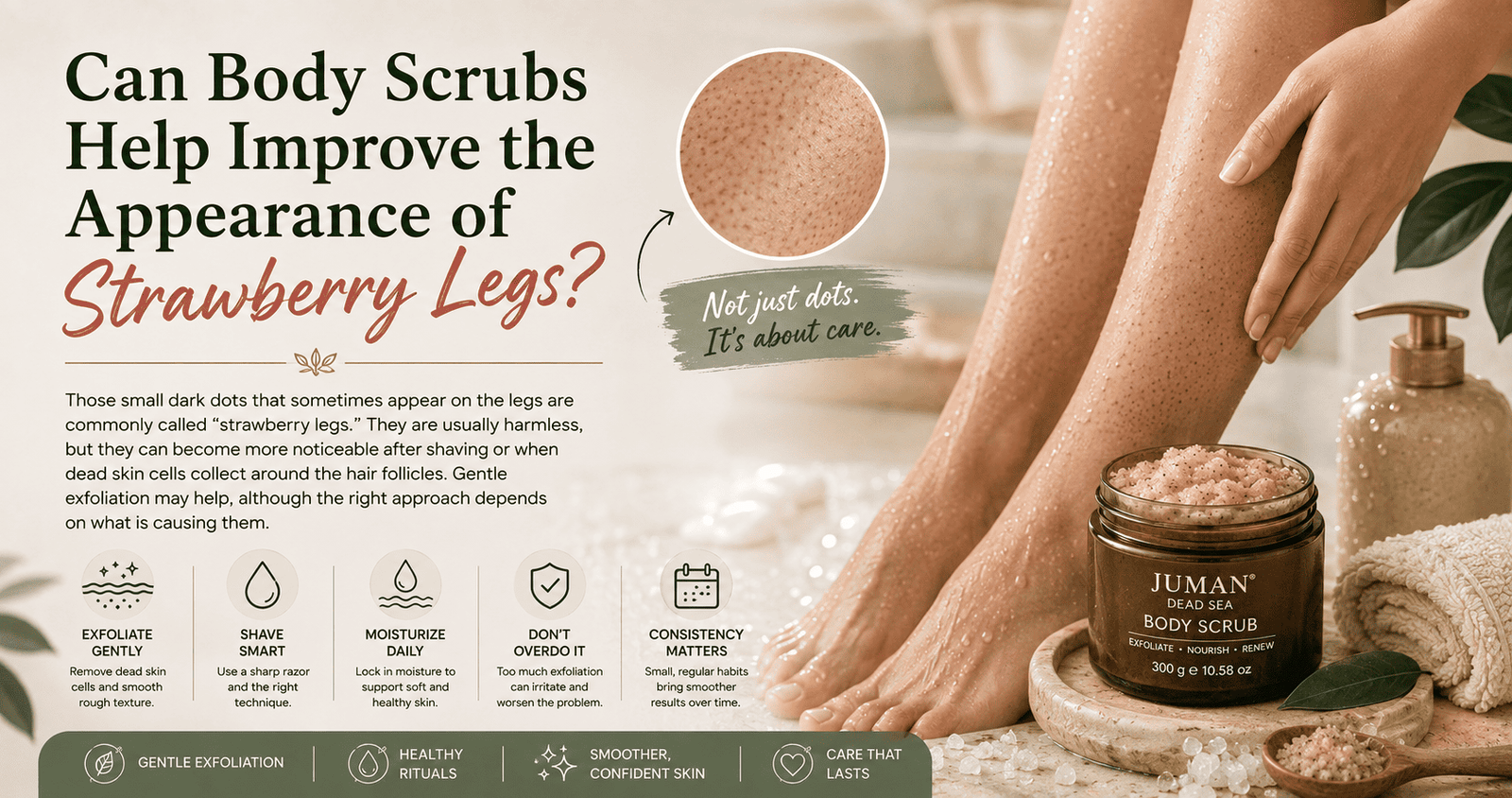
Those small dark dots that sometimes appear on the legs are commonly called “strawberry legs.” They are usually harmless, but they can become more noticeable after shaving or when dead skin cells collect around the hair follicles. Gentle exfoliation may help, although the right approach depends on what is causing them.
You have just shaved your legs, expecting them to look smooth, but instead you notice tiny dark dots scattered across the skin.
They look a little like the seeds on the surface of a strawberry, which is where the popular term “strawberry legs” comes from.
It can be tempting to reach for a body scrub and start exfoliating more often. Before doing that, it helps to understand why those dots appear in the first place. Strawberry legs can have several causes, and exfoliation is useful for some of them but not all.
What Are Strawberry Legs?
Strawberry legs is not a medical condition. It is an informal term used to describe dark or reddish dots that appear around the hair follicles, most commonly on the legs.
The appearance can develop when dead skin cells, oil, or other debris collect around the follicles. Shaving may make the dots more noticeable, particularly when the skin becomes irritated.
In some cases, what looks like strawberry legs may actually be related to ingrown hairs or keratosis pilaris, a common condition in which keratin builds up around hair follicles and creates small, rough bumps. Red or tender bumps may point to irritation or inflammation around the follicles rather than simple surface buildup.
This distinction matters because a body scrub is not suitable for every cause. Physical exfoliation may help when dead skin cells are contributing to roughness, but scrubbing irritated or inflamed skin can make it more uncomfortable. Keratosis pilaris also tends to respond better to gentle, consistent care than vigorous scrubbing.
Before reaching for a scrub, take a closer look at what you are actually seeing. Dark dots, rough bumps, ingrown hairs, and inflamed follicles may look similar from a distance, but they do not necessarily need the same approach.
Not All Exfoliation Works the Same Way
Exfoliation can help, but the type you choose matters.
A physical body scrub works mainly on the surface of the skin, helping to remove dead skin cells that can contribute to roughness and make hair follicles appear more noticeable. Used gently, it can leave the legs feeling smoother and improve their overall appearance.
Chemical exfoliants work differently. Ingredients such as salicylic acid, also known as BHA, can help loosen dead skin cells and work within oily, clogged follicles. Other ingredients commonly found in body care, including lactic acid and urea, may also help improve rough or bumpy texture.
This does not mean chemical exfoliation is automatically better than a body scrub. The right choice depends on what is contributing to the appearance of your skin. Surface roughness may respond well to gentle physical exfoliation, while persistent clogged follicles or bumps may benefit from a different approach.
Whichever method you choose, more exfoliation is not necessarily better. Scrubbing too hard or combining several exfoliating products at once can irritate the skin and weaken its protective barrier.
How Often Should You Use a Body Scrub?
There is no need to exfoliate your legs every day.
For most people, once or twice a week is a sensible place to start. If your skin is sensitive, once a week or even less frequently may be more appropriate.
When using a body scrub, apply it to damp skin and massage gently rather than pressing firmly. The exfoliating particles should do the work, so there is no need for aggressive scrubbing.
A product such as Juman Dead Sea Body Scrub can be incorporated into a weekly body care routine for physical exfoliation.
When publishing: hyperlink Juman Dead Sea Body Scrub directly to the relevant MyTradeMartStore product or collection page.
Pay attention to how your skin responds. If your legs become red, irritated, or unusually sensitive afterwards, stop exfoliating and allow the skin to recover before considering whether to use it again.
Your Shaving Routine Can Make a Difference
If the dots are particularly noticeable after shaving, it is worth looking at how you shave as well as how you exfoliate.
Using a dull razor, shaving without enough lubrication, or repeatedly passing the blade over the same area can irritate the skin surrounding the hair follicles. Using a clean, sharp razor with a suitable shaving gel or cream can help reduce unnecessary friction.
If you prefer to exfoliate on the same day you shave, do so gently before shaving. Avoid using a physical scrub immediately afterwards, when freshly shaved skin may already be more sensitive.
The aim is to make shaving gentler on your skin rather than trying to remove every visible sign of a hair follicle.
Moisturizing Matters Too
It is easy to focus entirely on exfoliation when trying to improve the appearance of strawberry legs, but keeping the skin moisturized is equally important.
After showering, apply moisturizer while your skin is still slightly damp. This helps reduce moisture loss and can leave the legs feeling softer and more comfortable.
Depending on your skin’s needs, ingredients such as glycerin, ceramides, shea butter, and plant based oils can help provide hydration or support the skin’s natural barrier.
If you are already using an exfoliating body product, resist the temptation to add several more treatments at the same time. Introducing too many exfoliating products can irritate the skin, particularly if you also shave regularly.
Keep the Routine Simple
If strawberry legs are bothering you, start with a few manageable changes rather than completely overhauling your routine:
- Cleanse gently and avoid products that leave your legs feeling tight.
- Exfoliate gently once or twice a week, or less frequently if your skin is sensitive.
- Use a clean, sharp razor with enough shaving gel or cream to reduce friction.
- Moisturize after showering, preferably while your skin is still slightly damp.
- Give your skin time to respond before adding more products or increasing the frequency of exfoliation.
If your skin is eczema prone or already irritated, a physical scrub may not be appropriate until the skin has settled. Bumps that become painful, persistently red, inflamed, or worse over time should be assessed by a healthcare professional rather than treated with more exfoliation.
So, Will a Body Scrub Get Rid of Strawberry Legs?
Not necessarily, and that is an important distinction.
A body scrub may make strawberry legs less noticeable when surface buildup and roughness are contributing to their appearance. It can also help the legs feel smoother. However, it cannot address every possible cause of visible follicles or bumps.
Your shaving habits, skin type, level of irritation, and the way you care for your skin after showering can all influence how your legs look and feel.
It is also worth remembering that perfectly poreless legs are not a realistic skincare goal. Hair follicles are a normal part of skin, and some will naturally remain visible.
If you want smoother looking legs, start gently. Exfoliate according to your skin’s needs, moisturize regularly, and avoid the temptation to scrub harder in pursuit of faster results.
When it comes to exfoliation, a gentler and more consistent approach is usually better than doing more.